Coredge Kubernetes Platform (CKP)
Enterprise Kubernetes Distribution White Paper
A complete, CNCF-certified Kubernetes distribution with integrated cluster lifecycle management, built for enterprise-grade deployments across baremetal and virtual infrastructure.
Version 1.0 | April 2026
1. Executive Summary
CKP (Coredge Kubernetes Platform) is a custom Kubernetes distribution built and maintained by Coredge.io. It takes upstream Kubernetes source code and produces enterprise-grade, digitally signed binaries and container images, providing organizations with a fully supported, supply-chain-verified Kubernetes platform.
The platform operates across two layers: the CKP Distribution Layer, which delivers custom-built Kubernetes packages and Coredge-hosted core component images; and the CKP Management Layer, which handles cluster lifecycle management through CAPI (Cluster API) with Managed Control Plane.
CKP currently supports Kubernetes versions v1.33.7 through v1.35.1, all CNCF Certified, running on Ubuntu 22.04, Ubuntu 24.04 and Red Hat Enterprise Linux 9 across both baremetal and virtual infrastructure.
Key capabilities include PGP-signed package distribution via BYOH (Bring Your Own Host) bundles, automated cluster provisioning through the Compass UI and API, Ceph-backed persistent storage, Velero backup and disaster recovery, and TLS certificate management with 10-year validity. The platform integrates Cluster API v1.7.7, Managed Control Plane, BYOH Infrastructure Provider v0.6.1, and Cert-Manager v1.15.3.
2. Why CKP
CKP is not just a management plane — it is a full-stack offering that spans two layers: the CKP Distribution Layer and the CKP Management Layer. This combination delivers several advantages:
- Automated rollouts, scaling, and rollbacks — Automatic replica creation, hardware distribution, rescheduling on node failure, on-demand scaling
- Service discovery, load balancing, and network ingress — Complete networking solution for internal discovery and external exposure
- Stateless and stateful applications — Full support for both workload types
- Storage management — Persistent storage abstracted across cloud and local providers
- Declarative state — YAML manifests define desired state; Kubernetes transitions automatically
- Works across environments — Cloud, edge, and developer workstations
- Highly extensible — Custom object types, controllers, and operators via CRDs
All supported CKP Kubernetes versions are CNCF Certified, ensuring conformance with the official Kubernetes specification. CKP binaries are digitally signed by Coredge.io using PGP, providing enterprise traceability and supply chain integrity.
3. Introducing CKP
CKP is not just a management plane — it is a full-stack offering that spans two integrated layers:
Distribution Layer
Custom-built Kubernetes binaries (kubeadm, kubelet, kubectl) tagged with a -ckp version suffix and digitally signed by Coredge.io using PGP. All core component container images (kube-apiserver, kube-scheduler, kube-controller-manager, etcd, CoreDNS, kube-proxy, pause) are hosted on the Coredge Docker Hub registry.
Management Layer
Cluster lifecycle management via CAPI (Cluster API), with Managed Control Plane for hosted control planes, automated provisioning through the Compass platform, and integrated addons for storage, networking, backup, and autoscaling.
CKP binaries are functionally identical to upstream Kubernetes, but are versioned, packaged, and digitally signed by Coredge.io for enterprise traceability and supply chain integrity.
4. Platform Architecture
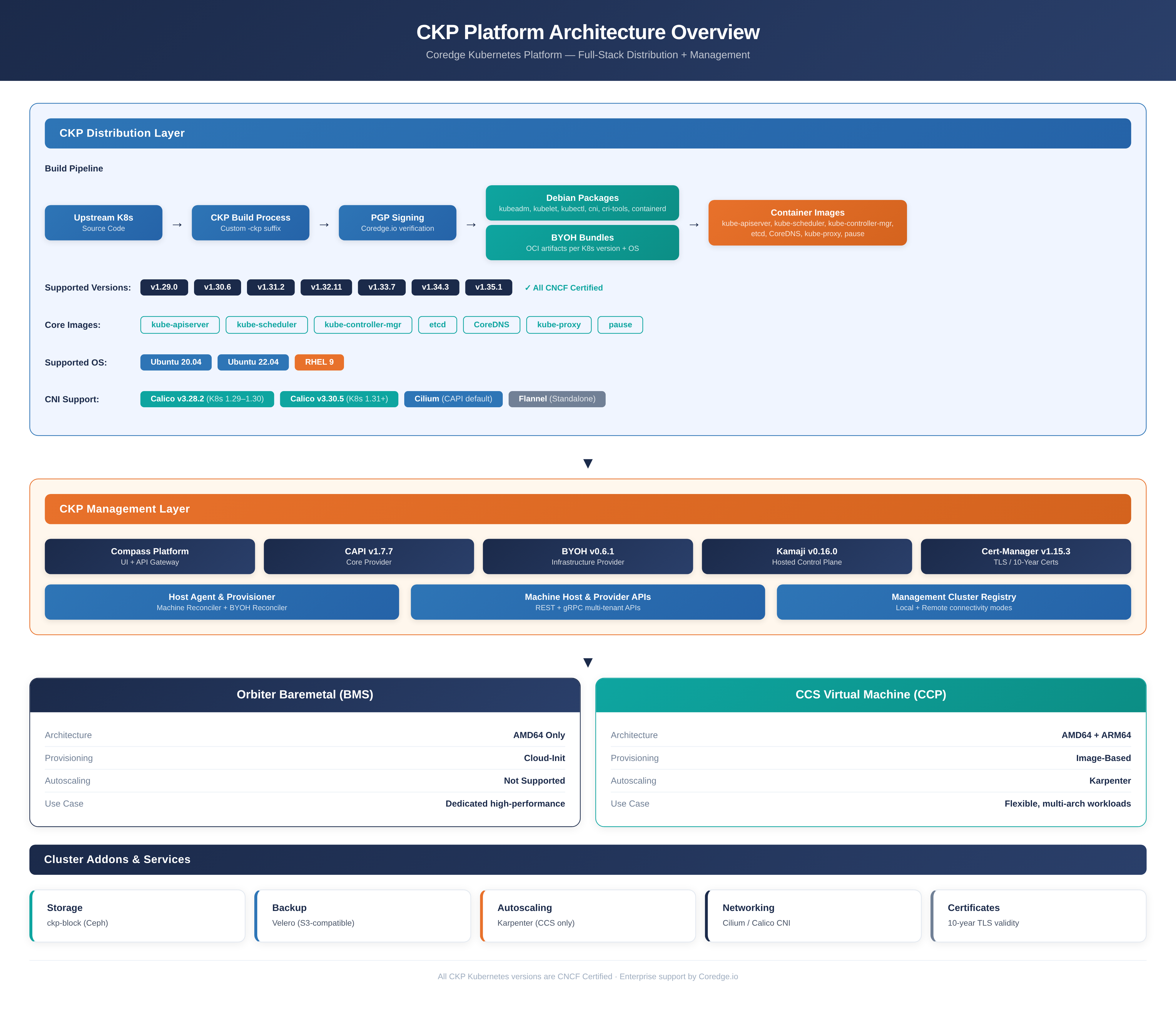
The architecture separates concerns between the Distribution Layer (package build, signing, and delivery) and the Management Layer (cluster provisioning, lifecycle, and addons), enabling independent versioning and operational flexibility.
5. CKP Distribution Layer
5.1 Build Process
CKP takes the upstream Kubernetes source code at a specific version and produces custom-tagged binaries. The build process outputs a set of custom Debian packages and Coredge-hosted container images for all core Kubernetes components.
5.2 Package Signing
All CKP packages are digitally signed by Coredge.io using PGP. Before any installation proceeds, a mandatory integrity verification is performed automatically, including PGP signature validation and Coredge.io maintainer confirmation. If either check fails, the installation is aborted.
5.3 BYOH Bundle Distribution
For CAPI-managed cluster provisioning, CKP packages are distributed as BYOH (Bring Your Own Host) bundles — OCI-compliant image artifacts hosted on the Coredge Docker Hub registry. Each bundle contains all required packages for a specific Kubernetes version and operating system, pulled onto target hosts using imgpkg during provisioning.
| Operating System | Availability |
|---|---|
| Ubuntu 22.04, Ubuntu 24.04 | Available for all supported K8s versions (v1.33.7+) |
| Red Hat Enterprise Linux 9 | Available for all supported K8s versions (v1.33.7+) |
5.4 Supported Kubernetes Versions
CKP currently supports three CNCF Certified Kubernetes versions with CNI (Calico v3.30.5) support:
| K8s Version | CNI (Calico) | CNCF Certified | Status |
|---|---|---|---|
| v1.33.7 | v3.30.5 | Yes | Supported |
| v1.34.3 | v3.30.5 | Yes | Supported |
| v1.35.1 | v3.30.5 | Yes | Supported (Latest) |
6. CKP Management Layer
The management layer orchestrates the entire cluster lifecycle through several integrated components:
6.1 Compass Platform
The Compass platform provides a unified UI and API for cluster creation, management, and monitoring. Users configure Kubernetes version, CNI, worker host groups, and node counts through a guided workflow. The platform also exposes REST and gRPC APIs for programmatic cluster management.
6.2 CAPI Integration
CKP integrates Cluster API (CAPI) as the core lifecycle management engine:
| Provider | Type | Version |
|---|---|---|
| Cluster API | Core Provider | v1.7.7 |
| Kubeadm | Bootstrap Provider | v1.7.7 |
| Managed Control Plane | Control Plane Provider | - |
| BYOH | Infrastructure Provider | v0.6.1 |
| Cert-Manager | Certificate Management | v1.15.3 |
6.3 Managed Control Plane
CKP uses Managed Control Plane as the hosted control plane provider. For each managed cluster, the Managed Control Plane creates a full set of CAPI resources including the control plane (with Konnectivity agent, CoreDNS, KubeProxy, and LoadBalancer), the BYOH infrastructure binding, machine deployment configurations, and bootstrap templates. This approach keeps control plane components off the worker nodes, reducing resource overhead and simplifying management.
7. Infrastructure Provider
CKP integrates with Orbiter Baremetal infrastructure, enabling Kubernetes clusters to be provisioned directly on physical servers.
Orbiter Baremetal Provider (BMS)
The BMS Provider handles automated server allocation and release, cloud-init provisioning, and hardware secret management. Baremetal deployments support AMD64 architecture.
| Capability | Description |
|---|---|
| Server Allocation | Automated allocation and release of baremetal servers |
| Cloud-Init Provisioning | Server initialization using cloud-init templates |
| Hardware Secret Management | Secure handling of hardware credentials and access keys |
Supported Architecture: AMD64
Supported OS: Ubuntu 22.04, Ubuntu 24.04, RHEL 9
8. Cluster Lifecycle Management
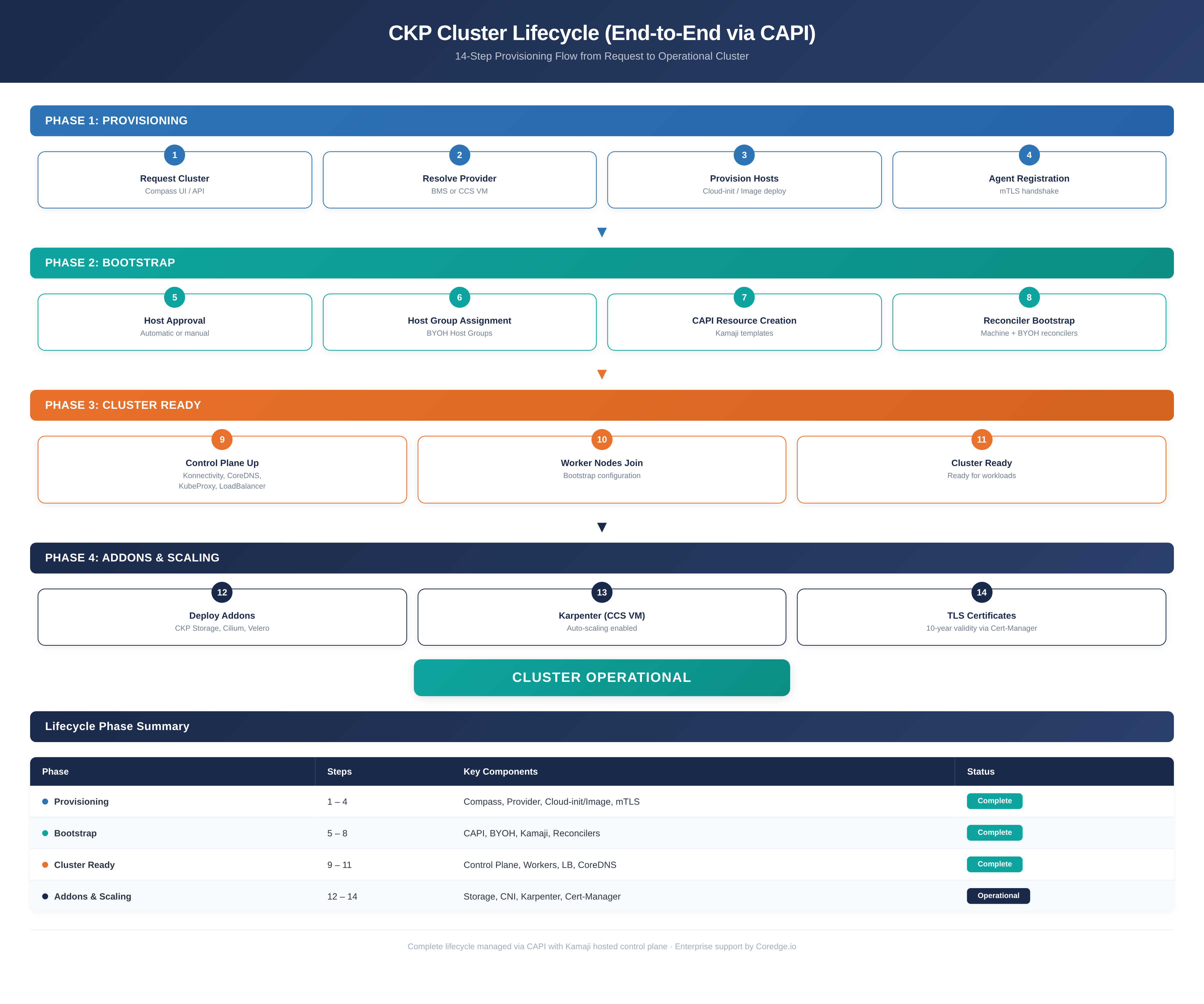
CKP provides a complete end-to-end cluster lifecycle through CAPI, from initial provisioning to fully operational state with all addons deployed.
The lifecycle follows 14 steps organized into four phases:
- Provisioning — Request, provider resolution, host provisioning, agent registration
- Bootstrap — Host approval, group assignment, CAPI resource creation, reconciler bootstrap
- Cluster Ready — Control plane up, workers join, ready state
- Addons — Storage, CNI, backup, TLS certificates
CKP also supports rolling upgrades across Kubernetes versions using a node-by-node drain, install, restart, and uncordon pattern to maintain cluster availability throughout the upgrade process.
9. Security and Compliance
Security is embedded throughout the CKP platform:
9.1 Supply Chain Integrity
- PGP-signed packages — All CKP binaries are digitally signed by Coredge.io
- Mandatory verification — Installation scripts validate PGP signatures and maintainer fields before proceeding
- Coredge-hosted images — All core component images are sourced from Coredge's signed and maintained registry
9.2 Network Security
- Mutual TLS (mTLS) — Host agents register with the management plane via mTLS
- Configurable CIDR — Pod and Service network ranges are fully configurable during cluster creation
9.3 Certificate Management
CKP includes a built-in certificate management system powered by Cert-Manager v1.15.3. Certificates are issued with a 10-year validity period, ensuring long-term operational stability. The certificate manager integrates with a Root CA for trust chain establishment.
9.4 CNCF Certification
All supported CKP Kubernetes versions are CNCF Certified, ensuring conformance with the official Kubernetes specification. This guarantees workload portability and compatibility with the broader Kubernetes ecosystem.
10. Storage and Backup
10.1 CKP Storage Plugin
CKP provides a built-in storage plugin backed by Ceph. The default storage class (ckp-block) is configured with a Delete reclaim policy and volume expansion enabled. For standalone installations, OpenEBS hostpath serves as the default CSI driver.
10.2 Velero Backup
CKP integrates Velero for cluster backup and disaster recovery with S3-compatible storage. The backup system provides storage location management, lifecycle handling, cloud provider configuration, and project-level isolation.
11. Supported Configurations
11.1 Compatibility Matrix
| K8s Ver | etcd | CoreDNS | Containerd | CRI | Pause | Calico | CNCF |
|---|---|---|---|---|---|---|---|
| v1.33.7 | 3.5.15-0 | v1.11.3 | 1.7.0+ | v1 | v3.10 | v3.30.5 | Yes |
| v1.34.3 | 3.5.15-0 | v1.11.3 | 1.7.0+ | v1 | v3.10 | v3.30.5 | Yes |
| v1.35.1 | 3.5.15-0 | v1.11.3 | 1.7.0+ | v1 | v3.10 | v3.30.5 | Yes |
11.2 System Prerequisites
| Dependency | Details |
|---|---|
| Supported OS | Ubuntu 22.04, Ubuntu 24.04, Ubuntu 22.04, Red Hat Enterprise Linux 9 |
| Container Runtime | Containerd (v1.6.14+) |
| OCI Runtime | runc (v1.1.3 – v1.1.10) |
| CRI Tools | crictl (v1.27.0) |
| CNI Plugins | v1.1.2 – v1.3.0 |
| Helm | v3 (for addon installation) |
11.3 Supported CNIs
| CNI | Description |
|---|---|
| Calico (v3.30.5) | Default CNI in Compass UI. |
| Cilium | eBPF-based CNI. Default in CAPI-provisioned clusters. |
12. Summary
CKP delivers a complete, enterprise-ready Kubernetes platform that addresses the critical challenges of supply chain security, multi-cluster lifecycle management, and infrastructure diversity. By combining a PGP-signed custom distribution with an integrated CAPI-based management layer, CKP provides organizations with a single platform for deploying and operating Kubernetes at scale.
| Component | Details |
|---|---|
| Distribution | Custom-built K8s binaries (v1.33.7–v1.35.1), PGP-signed, CNCF Certified |
| Management | CAPI v1.7.7 + Managed Control Plane |
| Infrastructure | Orbiter Baremetal (BMS) |
| Networking | Calico v3.30.5, Cilium; Configurable CIDR |
| Storage | CKP Storage Plugin (ckp-block / Ceph) + OpenEBS (standalone) |
| Backup | Velero with S3-compatible storage |
| Security | PGP signing, mTLS, 10-year TLS certs, CNCF Certified |
| Operating Systems | Ubuntu 22.04, Ubuntu 24.04, Red Hat Enterprise Linux 9 |
| Architecture | AMD64 |
For more information about CKP, contact the Coredge.io platform team or visit the Compass management portal.